Two Tetrahedra, Seven Axes: Hybrid Combination Puzzles
- 3D , Math
- 06 Oct, 2026
An interactive companion to the patent application “Polyhedra for hybrid combination puzzles and a method of constructing them”.
Beyond the Rubik’s cube
A combination puzzle is a polyhedron whose faces are painted in different colours and whose parts can turn about several axes without changing the overall shape. You scramble it with turns and solve it with turns. Three families dominate:
- the Rubik’s cube — built from unit cubes, with three axes of the 4th order (90° turns) through the centres of opposite faces;
- the Pyraminx and other tetrahedra — built from small tetrahedra and octahedra, with four axes of the 3rd order (120°) through a vertex and the centre of the opposite face;
- octahedral puzzles like the Skewb Diamond — the same pieces, four 3rd-order axes through the centres of opposite faces.
Sizes are written n×n×n. Rubik’s cubes go past 20×20×20; tetrahedra and octahedra stop at about 5.
The catch is that the elementary piece dictates everything. Build from cubes and you get cube-shaped puzzles with cube axes. Build from tetrahedra and octahedra and you get tetrahedral or octahedral shapes with four axes. You cannot make a puzzle in the shape of some other polyhedron, and you cannot add axes.
The patent application proposes a different set of bricks — and with it a general method for building polyhedra that carry seven turning axes at once, in shapes nobody has made into puzzles before: cuboctahedra, truncated octahedra, hybrids of two different solids, and their star-shaped higher forms.
Two bricks
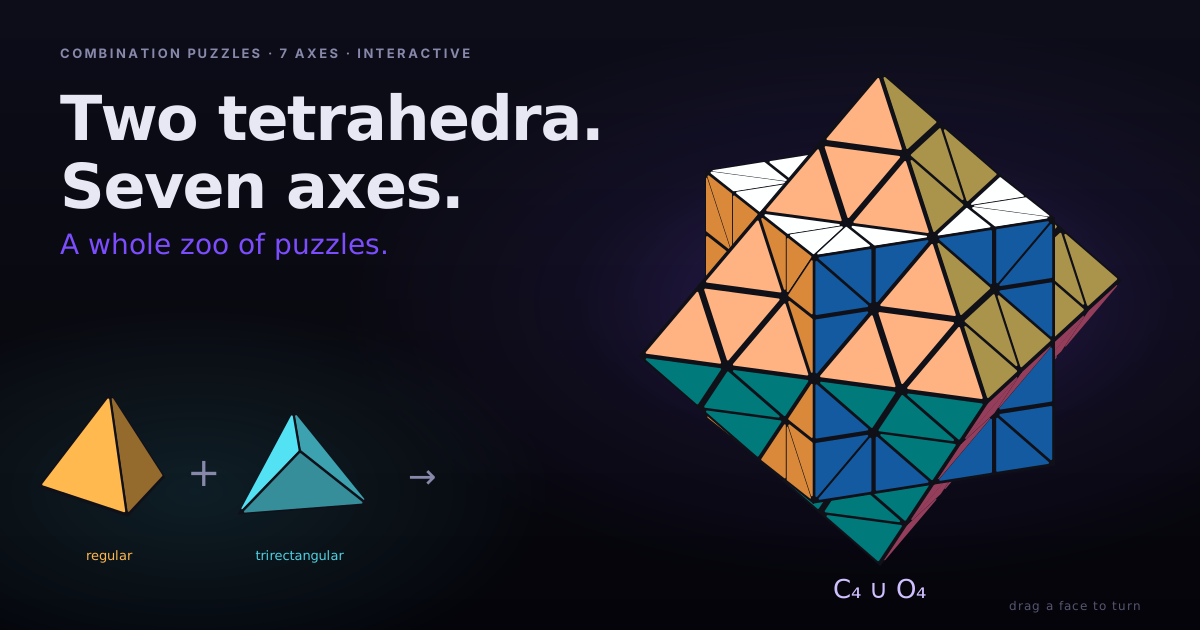
Everything is assembled from two elementary tetrahedra:
- the regular tetrahedron — all six edges of length a, all four faces equilateral triangles;
- the trirectangular (“corner”) tetrahedron — its base is an equilateral triangle with side a, its three lateral faces are right isosceles triangles meeting at a right-angled apex O, and its lateral edges are a/√2. It is literally the corner sawn off a cube: a tetrahedron with a low height.
From these two you can put together three primary polyhedra:
- the primary tetrahedron is simply the regular tetrahedron;
- the primary octahedron is eight corner tetrahedra joined by their lateral faces around a common apex O. It splits into two square pyramids, four oblique tetrahedra or eight corner tetrahedra — and its halves can already turn by multiples of 90°;
- the primary cube is one regular tetrahedron with four corner tetrahedra glued to its faces by their bases. Its edge is a/√2, and the four corner pieces can turn by multiples of 120° about the cube’s diagonals.
Two assembly rules keep everything consistent:
- a face of a primary tetrahedron may only touch the base of a corner tetrahedron, i.e. a face of a primary octahedron;
- lateral faces of corner tetrahedra touch each other leg to leg and hypotenuse to hypotenuse.
Break a rule and the cutting planes lose their integrity — the puzzle locks up.
Why seven axes
Here is the observation that makes the whole method click, and the one the simulator below is built on.
Take the edge of the primary cube as the unit of length and slice space with seven families of parallel planes:
| family | planes | perpendicular to |
|---|---|---|
| cube planes | x = k, y = k, z = k (k an integer) | axes X, Y, Z |
| octahedral planes | ±x ± y ± z = 2j (j an integer) | the four body diagonals A, B, C, D |
The pieces this cuts space into are exactly the two bricks. Every unit cube splits into one regular tetrahedron standing on its four “even” corners and four corner tetrahedra, one at each “odd” corner — the primary cube. Eight corner tetrahedra around the same odd lattice point form a primary octahedron.
So the two assembly rules really say “stay on the grid”. Any solid whose faces lie in these planes is automatically a stack of the two bricks, with all seven families of cutting planes running straight through it. Each family is perpendicular to an axis — three cube axes and four diagonal ones — and a slab between two neighbouring planes can turn whenever its shape maps onto itself.
For the classic shapes this means:
- tetrahedron: besides the four 3rd-order axes (120°), three new axes through the midpoints of opposite edges, with 180° turns. The face pattern does not change at all;
- octahedron: besides the four axes through opposite faces (120°), three axes through opposite vertices with 90° turns;
- cube: besides the familiar three axes (90°), four diagonal axes with 120° turns. The diagonal cuts split every square sticker into two independent right triangles.
Interactive explorer
Builder. Pick a family and its parameters — size, truncation, the patent’s (i, k) for hybrids, the stellation form — or type a formula. The preview is drawn in the style of the application’s figures, with the constituent solids of a hybrid outlined. The catalogue holds every solid illustrated in the application. Generate assembles the puzzle element by element, following the patent’s construction method, on a timeline you can scrub.
Puzzle. Drag any face to turn a slab; the axis is chosen from the direction of your drag, out of all seven. You can also pick an axis and a slab on the left, or use the keyboard (X Y Z A B C D, arrows, U). Scramble, undo, redo, and solve by replaying the history backwards.
Views. Stickers, the patent’s drawing style, anatomy (regular vs corner tetrahedra), primary octahedra, construction stages, slabs. Explode the pieces apart or cut a section along any axis.
Info panel. Patent-style name, formula, element counts checked against the patent’s formulas, symmetry group, and the number of slabs and turn angle for every axis.
The zoo
Primitives and their element counts
The patent builds each solid in layers. A tetrahedron of size n: a row of n primary tetrahedra, then n − 1, down to one; primary octahedra into the gaps; tetrahedra pointing down into the recesses on top; then the next, smaller layer. An octahedron: layers of square pyramids (half-octahedra), tetrahedra standing on edges between them, and inverted pyramids in the recesses. A cube: n×n×1 slabs of primary cubes. The Generate button replays exactly these steps.
The counts come out in closed form:
| solid | primary tetrahedra Nₜ | primary octahedra Nₒ |
|---|---|---|
| tetrahedron{n} | (n³ + 2n) / 3 | (n³ − n) / 6 |
| octahedron{n} | 4(n³ − n) / 3 | (2n³ + n) / 3 |
| cube{n} | n³ | n³ / 2 |
The number of corner tetrahedra is 8·Nₒ. The simulator counts its cells independently and checks them against these formulas — that is the green ✓ in the info panel.
Cubes have a subtlety. Even cubes have the full symmetry of the octahedron and come in two forms: in form I a corner tetrahedron sits at every vertex; in form II one regular and three corner tetrahedra meet there. You switch forms by moving one n×n×1 slab to the opposite side. Odd cubes only have tetrahedral symmetry: four vertices of one type, four of the other. A 90° turn is still possible, but it blocks the 3rd-order axes until you undo it.
Truncations
Cutting fragments off the vertices gives the k-polyhedra, including several Archimedean solids:
- truncated tetrahedron{k} = tetrahedron{3k} with four tetrahedra{k} removed;
- cuboctahedron{k} = octahedron{2k} with six square pyramids{k} removed — or cube{2k} with eight corner tetrahedra{k} removed;
- truncated octahedron{k} = octahedron{3k} with six pyramids{k} removed.
A truncated cube with regular octagonal faces cannot be built this way, but it can be approximated as closely as you like. An odd cube cannot be truncated symmetrically at all.
Hybrids
A hybrid is the union of two solids of different type or size that share a centre — the patent also calls it their first stellated form. There are four families:
| family | union | sizes | when i = 0 |
|---|---|---|---|
| paratetrahedron | tetrahedron{m} ∪ inverted tetrahedron{n} | m = 3i + 2k, n = i + 2k | stellated octahedron{k} |
| tetrahexahedron | tetrahedron{m} ∪ cube{n} | m = 3i + k, n = i + k | cube{k} |
| tetraoctahedron | tetrahedron{m} ∪ octahedron{n} | m = 2i + 2k, n = 3i + k | tetrahedron{2k} |
| hexaoctahedron | cube{m} ∪ octahedron{n} | m = 2i + 2k; n = i + 2k or n = 3i + 2k | stellated cuboctahedron{k} |
Here k is the size of the attached fragment and i is the number of the plane, counted from the edge of the larger solid, that the fragment’s base touches.
None of these formulas is programmed into the simulator. It only knows the grid: two solids form a valid hybrid when they can share a centre and every face lies in a grid plane. All the size relations above fall out of that one condition. In the Builder, each hybrid family gets a map of all (m, n) pairs up to 14: bright dots are true hybrids, dim ones are pairs where one solid hides entirely inside the other. Going the other way, the search turns up no valid hybrid outside the patent’s formulas (checked exhaustively up to size 8).
Hybrids can be truncated too — the 2-paratetrahedron{5,3} is a truncated tetrahedron fused with an inverted one, with twelve faces.
Higher stellations
Most hybrids have higher stellated forms. You get them by extending the face planes of one type until they meet the extended planes of the other. The patent works this out for the cuboctahedron{1} in four stages. Form I is cube{2} ∪ octahedron{2}. Form IV is the union of the stellated octahedron{2} and six square prisms with pointed tips.
In the simulator, the stellation level s means: add every bounded region of the face-plane arrangement that lies outside at most s of the face planes. For the cuboctahedron this reproduces forms I–IV exactly — form IV is checked cell by cell against the patent’s description — and form V adds nothing. For other hybrids it is the natural generalisation; try the 2-paratetrahedron{5,3-III}.
A solid of this method has at most fourteen face directions, so the sticker palette has fourteen colours.
A notation for the zoo
The patent names solids as polyhedron{n-F}, k-polyhedron{n} and hybrid{m,n-F}. For a simulator I wanted something you can type, compose and compute with, so here is a proposal — TOC notation (Tetrahedron, Octahedron, Cube):
| formula | meaning | patent name |
|---|---|---|
T3 | regular tetrahedron of size 3 | tetrahedron{3} |
T'3 | the inverted tetrahedron | |
O4, C4 | octahedron, cube | octahedron{4}, cube{4-I} |
C4' | an even cube in its second form | cube{4-II} |
2-T6 | a size-2 fragment cut off every vertex | truncated tetrahedron{2} |
T5+T'3 | union about a common centre | paratetrahedron{5,3-I} |
C6+O7 | hexaoctahedron{6,7-I} | |
C2+O2*3 | stellation level 3 | hexaoctahedron{2,2-III} |
The notation is algebraic, so one solid can have several spellings. The info panel finds them for you: 1-O2 ≡ 1-C2 (the cuboctahedron), 1-O2*1 ≡ C2+O2, O1*1 ≡ T2+T'2 (the stellated octahedron).
Moves are an axis, a slab number counted from the negative end of the axis, and a suffix: Z3 is +90°, Z3′ is −90°, X2² is 180°, A1 is +120°. Positive means counter-clockwise, seen from the positive end of the axis.
Slab signature. The info panel also shows something like 4·4·4 | 7·7·7·7 — the number of slabs along X·Y·Z and along A·B·C·D. It generalises “4×4×4” and tells you the turning structure at a glance. The two forms of the 4-cube look identical from outside, yet one is 4·4·4 | 7·7·7·7 and the other 4·4·4 | 6·6·6·6.
The patent’s claims, live
The simulator has no special rules. A slab may turn when its region maps onto itself under the rotation, and when no element straddles either of its cutting planes in the current state. That is all — and the patent’s statements follow:
- element counts match the formulas for every size;
- symmetry is computed on the internal cell structure, not just the surface: even cubes come out as Oh, odd cubes as Td;
- in an odd cube a 90° face turn is allowed — and afterwards most slabs on the diagonal axes turn red, blocked until you turn the face back;
- tetrahedra turn only 180° about the cube axes and 120° about the diagonal axes.
A few things to try
- Load
C3, turn a face by 90°, then select axis A and watch the slabs lock. - Compare
C4andC4': same outside, different slab signature. - Type
1-O2*1and see the equivalentC2+O2appear. - Step through
C2+O2*1…C2+O2*4and replay each assembly with the Stages colouring. - Anatomy colouring plus explode on
O3shows how corner tetrahedra pair up into primary octahedra. - Open the hexaoctahedron family and click around the map of allowed ratios.
Under the hood
All coordinates are kept as integers (doubled and centred on the solid), so any sequence of turns is exact — no drift, no snapping. Each element remembers only which of the 24 rotations of the cube has been applied to it. The rendering uses two instanced meshes, one per type of tetrahedron. A single shader draws the rounded stickers, the patent-style edge lines and the anatomy colours from per-triangle edge distances. The geometry engine is plain JavaScript and is tested against the patent’s claims.
If you found this useful, consider supporting my work

Tags:
- Polyhedra
- Combination puzzles
- Rubiks cube
- Geometry
- Tetrahedron
- Three js
- Interactive