Why Wi-Fi won't power your sensors
- Engineering , Physics
- 11 May, 2026
The dream: free radio energy
Imagine a world where sensors run with no batteries — they just scavenge the radio waves that flood the air around us. Wi-Fi, Bluetooth, cell towers, digital TV. Tens of megawatts of RF energy are flying around any city at every moment. What stops us from catching it?
The answer is one formula — the Friis transmission equation:
Received power drops quadratically with distance and quadratically with frequency. That’s harsher than your intuition expects.
The two power killers
In log units the formula becomes clearer:
What this means:
- Every doubling of distance costs −6 dB — power divides by 4.
- Every doubling of frequency costs another −6 dB.
- 24 GHz at 10 m loses about 28 dB more than 900 MHz at 1 m.
Rectifier diodes — the part that converts RF back into DC — have a sensitivity floor around −20 dBm (~10 µW). Anything below that, the diode simply doesn’t open and the captured RF just heats it up. It’s a physical wall, not a problem you optimize around.
A Wi-Fi router in the next room (100 mW transmitter, ~4 dBi antenna, 5 m away) puts roughly −28 dBm at a smartphone antenna — about six times less power than the simplest rectifier needs to start working.
Interactive link budget
Every parameter in Friis is a slider, and the consequences show up on four visualizations at once:
- Log-log plot — Pᵣ as a function of distance for all four ISM bands simultaneously (900 MHz, 2.45 GHz, 5.8 GHz, 24 GHz). The yellow dashed line is the rectifier threshold; anything below it is wasted.
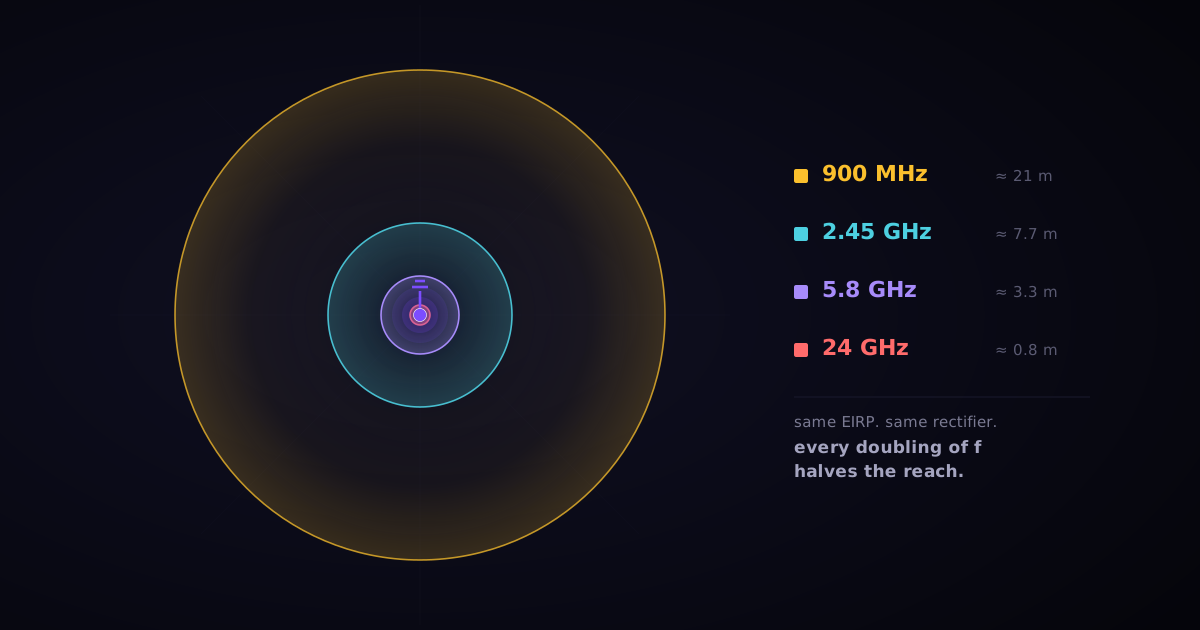
- Top-down view — the circle inside which RF harvesting is still possible. Its radius is dₘₐₓ — the distance where Pᵣ exactly equals the threshold.
- Harvest reach by band — horizontal bars comparing dₘₐₓ across all four bands under the same parameters. This is where the quadratic frequency penalty becomes viscerally obvious.
- Link budget table — in radio-engineer style: Pₜ → EIRP → FSPL → Gᵣ → Pᵣ — each step in dB and in linear units.
Things worth trying
A few scenarios that show the physics most cleanly:
- “Dedicated 900 MHz power beacon” (1 W, 12 dBi antenna, −20 dBm threshold) — the optimistic case. Zone reaches ~65 m. It works, but you need a purpose-built transmitter. This is not your Wi-Fi.
- “24 GHz mmWave @ 5 m” — at nearly the same parameters, the zone collapses to ~1.4 m. Going from 900 MHz to 24 GHz costs ~28 dB — exactly what the formula promises.
- “Wi-Fi router, next room” — the ambient scenario most people imagine. At 5 m from a 100 mW router with modest gains, Pᵣ ≈ −28 dBm. The diode never opens. Harvesting fails even if your rectifier is ideal.
- Drop the Pₘᵢₙ slider to −40 dBm and below — watch the zone explode. This is the frontier modern low-Vₜ harvester ICs are pushing on; below −40 dBm the noise floor takes over and there’s nothing left to do.
The takeaway
RF harvesting is real, but it lives in a narrow corner of parameter space: short distances, low frequencies, high antenna gains, specialized rectifiers. “Battery-free IoT powered by ambient Wi-Fi” is, for now, more press release than engineering reality.
The formula is one line. The intuition behind it takes a few sliders to settle into your head. Hopefully this tool makes that a little easier.
If you found this useful, consider supporting my work
Tags:
- Radio
- Antennas
- Friis
- Rf
- Wifi
- Link budget
- Energy harvesting
- Visualization
- Interactive