Which RF rectifier topology wins? It depends on the power.
- Engineering , Physics
- 12 May, 2026
When an antenna picks up an RF signal — from an RFID reader, a Wi‑Fi access point, or the ambient cellular bath — you have to decide what to do with the captured sinusoid. The obvious answer is “rectify it.” The harder question is how.
The textbook offers four reasonable choices: a single‑diode half‑wave rectifier, a Greinacher voltage doubler, a four‑diode full‑wave bridge, or a multi‑stage Cockcroft–Walton ladder. All four appear in real designs. They behave radically differently across the input‑power range — differently enough that it’s easy to reach for the wrong one if you reason about the topology alone and forget the operating regime.
So I built an interactive tool that puts all four side by side.
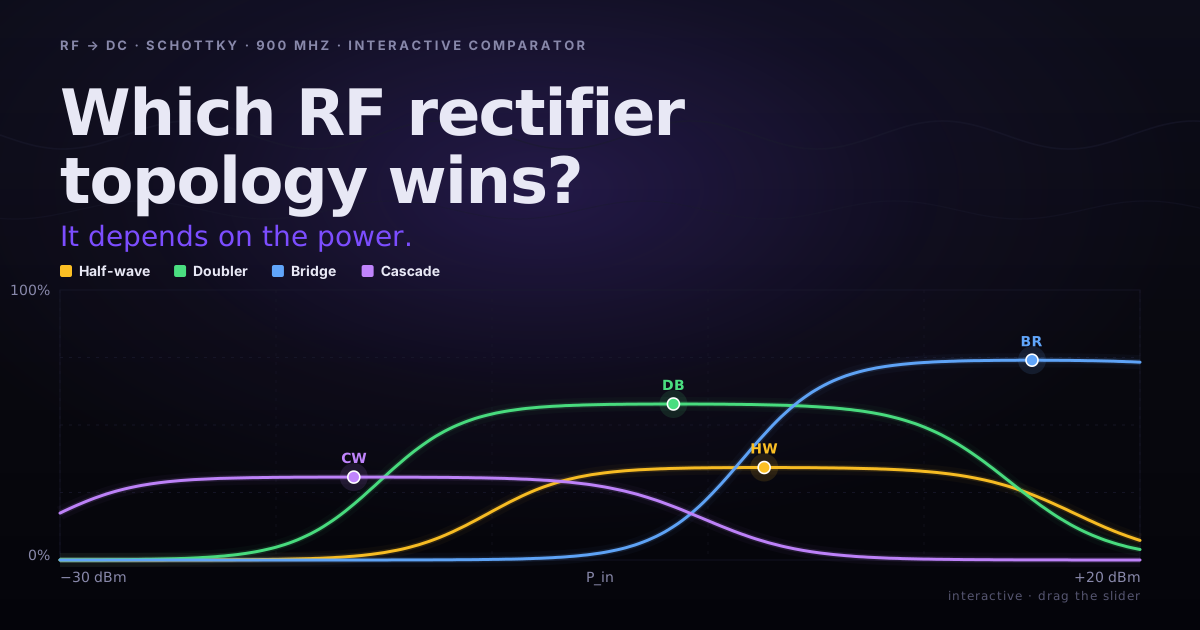
What you’re looking at: four real schematics with current paths animated per half‑cycle, plus an η-vs-P_in sweep that places a dot on each curve at the current operating point. Drag the P_in slider from −30 dBm (the microwatt RFID range) to +20 dBm (a healthy 100 mW) and watch the leader change.
Three observations worth internalizing:
- Below about −20 dBm, only the cascade and the doubler conduct at all. The bridge needs two diode drops of input — about 240 mV at V_D = 120 mV — before any current flows, and at 1 µW into a 50 Ω antenna, V_pk is only ~63 mV. The bridge is locked out.
- Above about +10 dBm, the cascade’s cumulative 2N·V_D losses dominate. The bridge wins on simplicity: only 2·V_D total, full‑wave operation, done.
- The half‑wave never wins, anywhere. Same V_D loss as the doubler, half the duty cycle. Drag the slider and try to find one operating point where it leads — there isn’t one. (It survives in practice only because the BoM is one diode.)
The crossover point depends quite sensitively on V_D. Drop it from 250 mV to 100 mV — the difference between a generic Schottky and an HSMS‑2850‑class part — and the doubler’s useful range extends about 8 dB downward. That alone often justifies the cost of low‑V_D parts in energy‑harvesting designs.
Every component, parameter, and formula has a tooltip — hover anything to see what it means and where the number comes from. Math is rendered through KaTeX. The toggle in the top‑right switches between English and Ukrainian.
If you found this useful, consider supporting my work
Tags:
- Rf
- Rectifier
- Energy harvesting
- Schottky
- Electronics
- Interactive